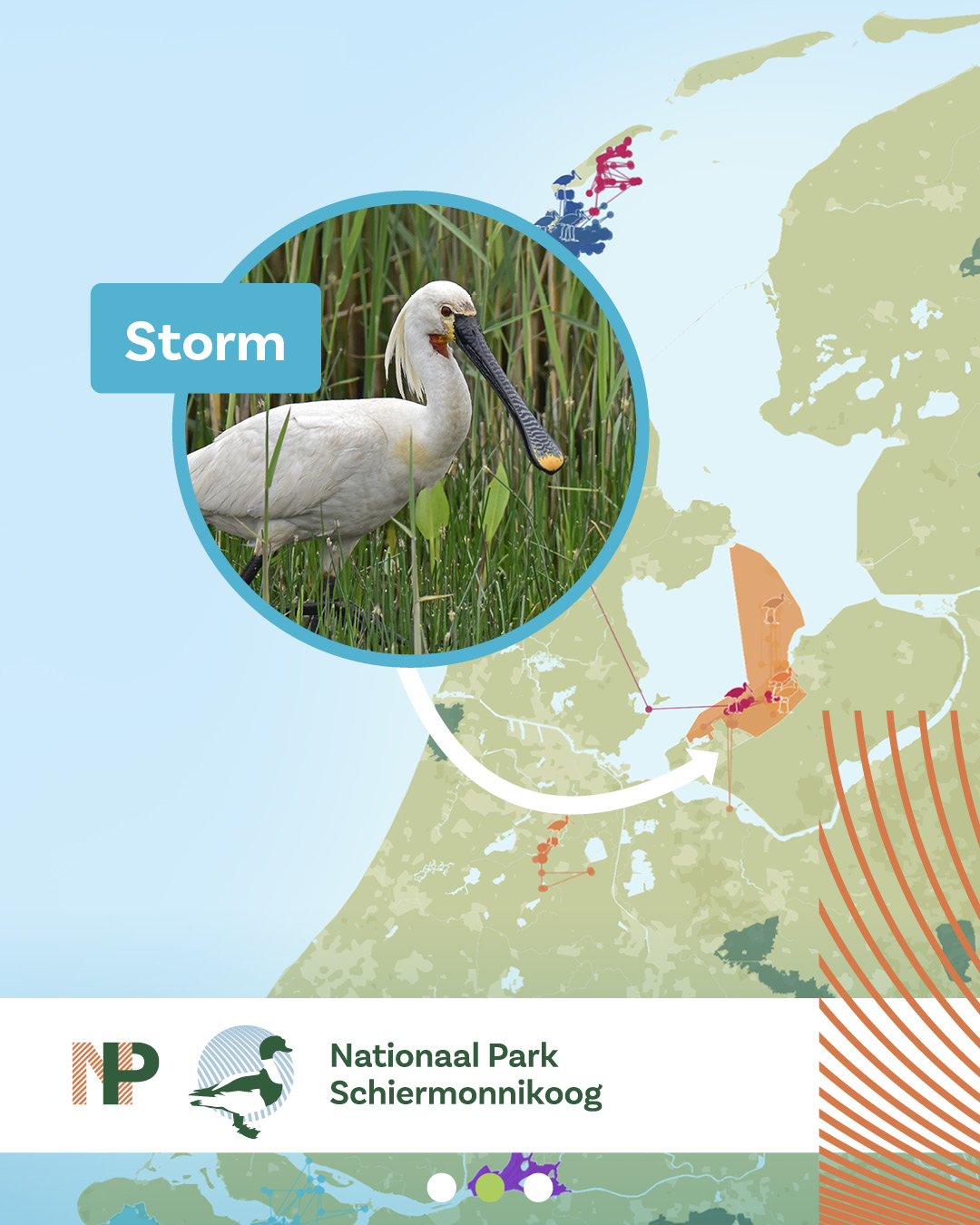
Each of the six national parks Lauwersmeer, Dunes of Texel, De Biesbosch, Schiermonnikoog, Nieuw Land, and Oosterschelde tells its own story about spoonbills based on transmitter data. This is a next step in the collaboration between these national parks, the National Parks Bureau (NPB), and research center BirdEyes, part of the University of Groningen.
Characteristics of national parks
The stories align with the characteristics of the national parks and how spoonbills use the areas. For instance, on Schiermonnikoog, it becomes visible what role the Wadden Sea area plays for spoonbills. The site also shows that breeding spoonbills on this Wadden island regularly cross over to Lauwersmeer National Park to forage. In Nieuw Land National Park, it's about the use of various wetland nature areas, and in Oosterschelde National Park, it concerns the relationship with the food-rich tidal nature.
Scientific information for a broad audience
The stories are based on data and observations from spoonbill researchers. The transmitter data makes it possible to track individual spoonbills and discover more about their behavior. At the same time, the routes clearly show that spoonbills do not adhere to area boundaries. They rely on a network of suitable areas to breed, forage, rest, and overwinter. The national parks form important links in that network.
Development
This spring, the first version of the website was launched. It focused on the general story of the spoonbill and its migration in the spring and autumn along the national parks on the East Atlantic migratory route. The expansion emphasizes the stories of the individual parks. Soon, this information will also be visible at physical locations in the six national parks, such as on screens in visitor centers.